I think his work should be better known.


Ceylon (as it was then) was a tropical paradise. Or perhaps not. My Father couldn't see a future there. So a boat, a suitcase, and cold welcome in a grey, smoggy, brick and bomb-site London, still knackered from the six year long war. It was a place where he knew no-one. But it was a place where he could start again. Or maybe just start.

He came to study architecture. And to become an architect. But he never qualified. He got distracted by art, and life, and the struggle to provide for a family. The art he got distracted, and inspired, by was abstract art. That wouldn't be a smart career move now. In 1953 – when most people's idea of art was Constable or Turner – it was
He came to study architecture. And to become an architect. But he never qualified. He got distracted by art, and life, and the struggle to provide for a family. The art he got distracted, and inspired, by was abstract art. That wouldn't be a smart career move now. In 1953 – when most people's idea of art was Constable or Turner – it was madness. But it was new, and now, and exciting. And so what if only a few people understood what the hell it was all about. He painted, he drew, he sculpted. He lived and breathed his art. And at one point the 'breathing' bit almost killed him. He explored, he expressed, he created. Because, it turns out, the art was in him, and he had to let it out.

I know. I shouldn't swear. But what can I tell you, he was. Within 5 years of arriving in London, knowing no-one, and never having really painted before, his work had been exhibited in London, Paris, Dublin, West Germany and the Smithsonian in Washington. So, yes, I am biased when I say he was a great artist. But I might just be right.

A lot more. Just keep scrolling through this website/exhibition for a deeper dive. And all I can tell you is that I'll try to make the telling of the story as interesting as I can. Both in content, and in form – an approach, I guess, I got from my Father. I mean, for example, is it wise to try and relaunch an unfairly forgotten great artist with a series of free articles on Substack? Only one way to find out:
https://myfatherwasagreatartist.substack.com/p/my-father-was-a-great-artist-i-think?r=5oamo
(P.S. Something else I also got from my Father was this birthday card. In 1968.)

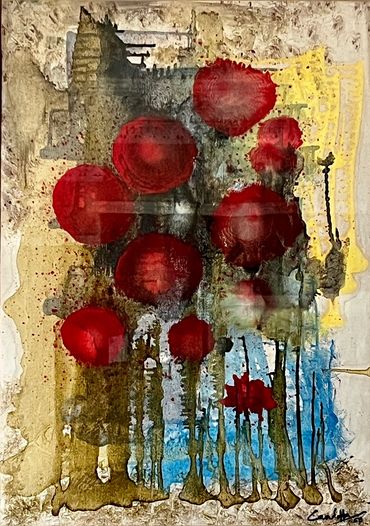
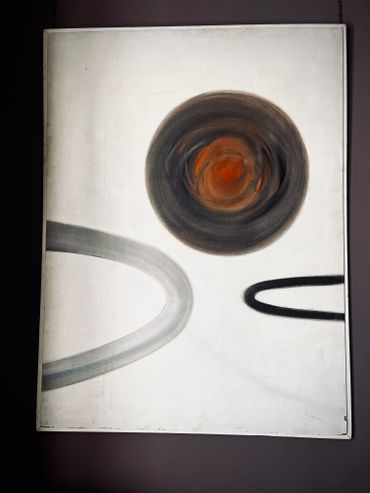
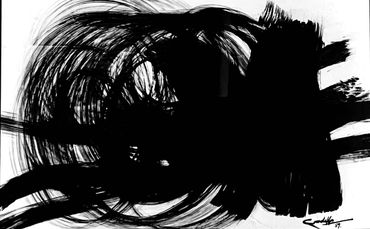
A painting from 1959. 'Abstract Expressionism' is probably how it would be classified now. But in letters I've seen of his from the time 'Non-Figurative' art is what was being discussed.

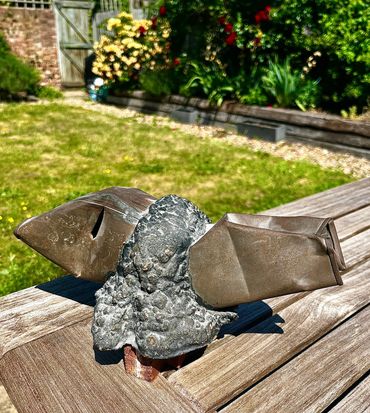
In contrast to the last painting this is the only figurative piece of work that I've ever seen from my Father. For the longest time I thought it was a woman's head. And then my brother explained that it's actually a Buddha. Which, obviously, made me feel a little bit stupid.

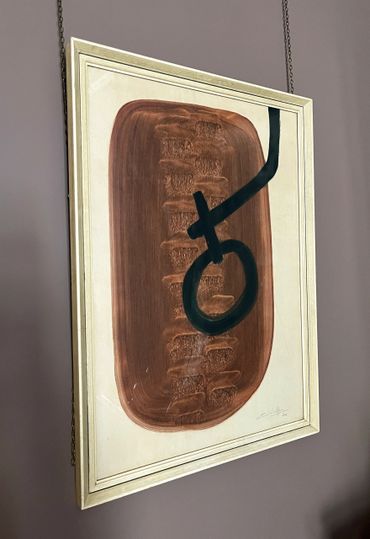
This piece from 1964 has a feel that became a definite thread in his work. I can only describe it as a kind of Contemplative Symbolism. It's a much more lyrical painting than the angularity of the first of these three pictures.
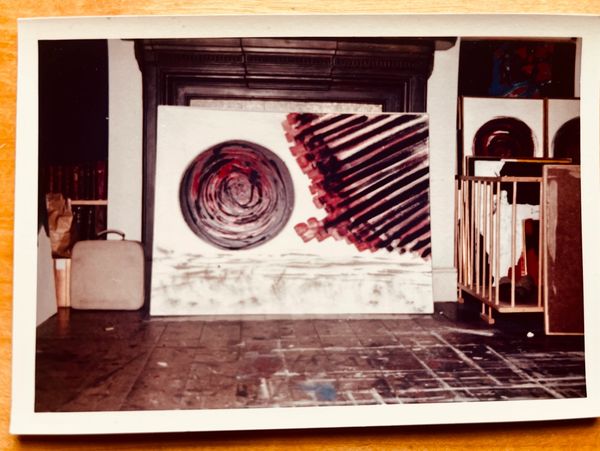
I don't know if these three paintings exist any more. I've never seen them. I've only ever seen these photographs taken in 1961.
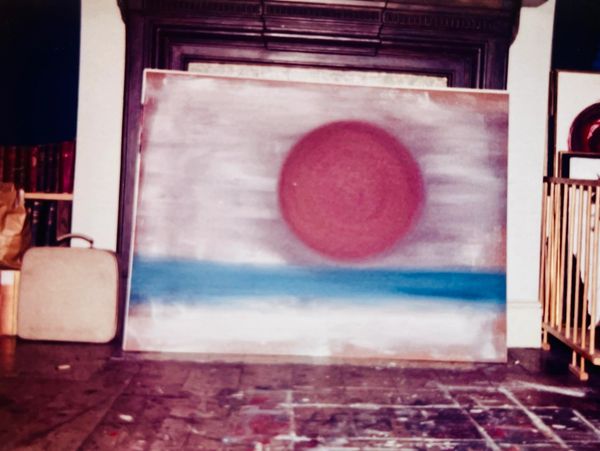
But they were painted. They did exist. And they did live a life out there in the world. Which is a beautiful, art-affirming thought.

Maybe they're still out there somewhere. Maybe someone's still interacting with them. Still enjoying them. Although, to be honest, they're probably gone.
Mind you, that's what Paul McCartney thought about his lost Hofner bass. His lost, 1961, Hofner bass. And then it turned up.
Committees are good at discussing, But, as I've found in my own life, for something to actually happen, someone has to commit.
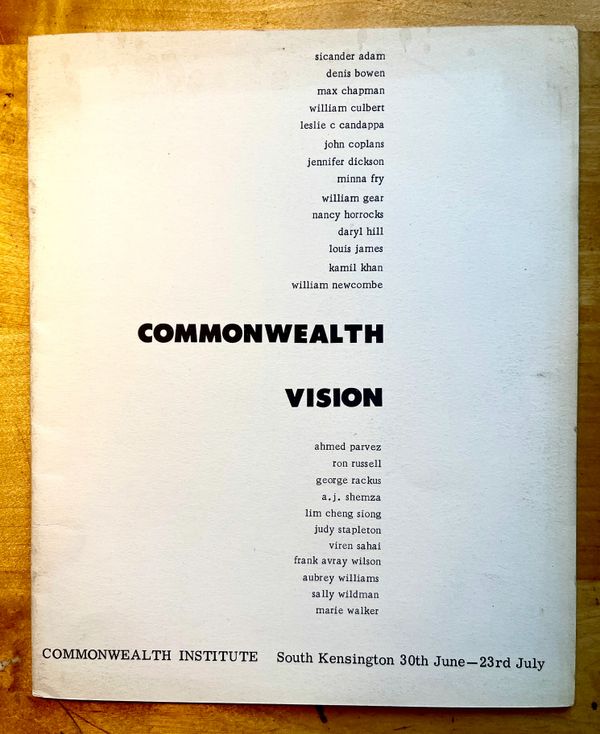
Since 1958 a small group of artists had discussed creating an exhibition of Commonwealth artists working in Britain. By 1961 my Father had joined the group, and he made it happen, because he became the 'main organiser' of COMMONWEALTH VISION at the Commonwealth Institute in South Kensington.
This groundbreaking show featured known abstract artists, but also new ones trying to get a break. And that was an aspect of my Father's life that many people have told me about – he poured belief into people. He wanted people to pursue their own path.
And speaking of new paths, the catalogue for the exhibition is worth considering. In terms of graphic design the look of the thing was definitely at the cutting edge of what was starting to happen. A minimalist grid layout, unfussy typefaces, and an egalitarian, cool, aesthetic.
Guess who designed it? And after you have, compare it to the paintings he was producing at the time. I find the contrast between these two planes of creativity remarkable.
My Father had shows here in '58, '60 and '62. The gallery was run by the remarkable South African-born, but Huddersfield-raised, Dennis Bowen. He championed artists from the Commonwealth when few of the established galleries would give them the time of day. He and my Father went on to work together organising The Commonwealth Biennale of Abstract Art at the Commonwealth Institute in Kensington in 1963. These days the site of The New Vision Centre Gallery is a Gail's coffee shop.
My Father had an exhibition here in 1962, in a spot just behind Carnaby Street. Today, just along from the gallery's location, you can see a plaque that commemorates 'Vince Man's Shop' – Britain's first menswear boutique in 1954. So in the 50s and 60s the Rawinsky Gallery was right at the centre of what became Swinging London. Today 10 Newburgh Street is where the tailor Mark Powell sells the sharpest of suits, to the most stylish people.

The Grabowski Gallery in Chelsea was founded by the Polish emigre Mateusz Grabowski who escaped the Nazis in 1940. After the war his successful pharmacy business meant he could pursue his love of art. Hence his gallery that pioneered work of new artists like Pauline Boty, Aubrey Williams, Bridget Riley and David Hockney. My Father had a show at The Grabowski in 1961. These days the site is occupied by a high-end leisure wear shop. Lovely stuff, but out of my price range. (A coffee at Gail's is a much more achievable aspiration).
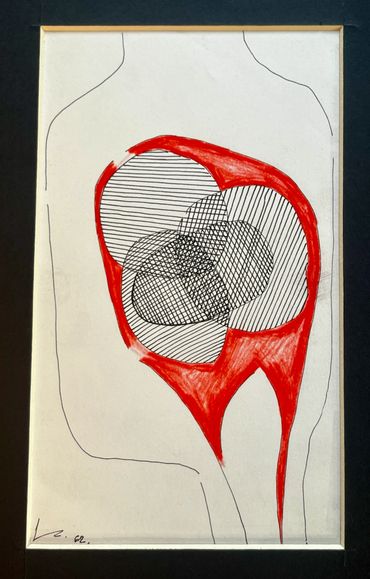
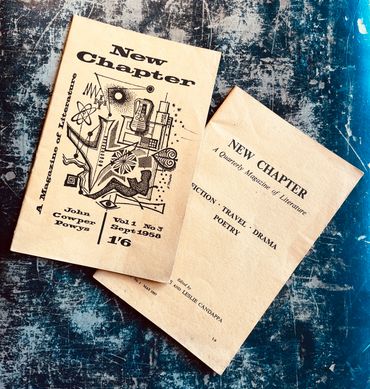
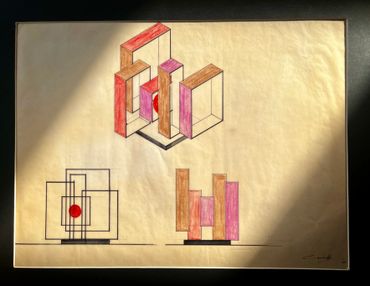
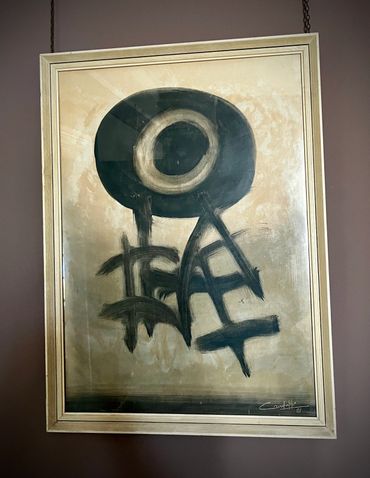
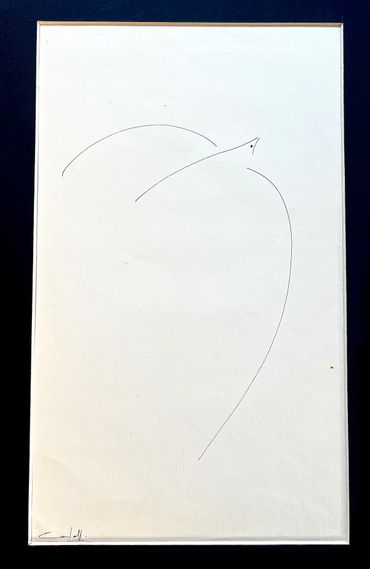
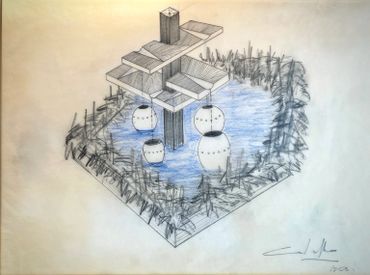
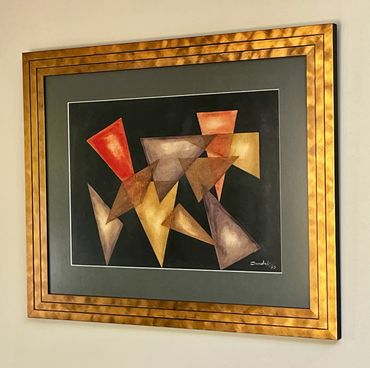
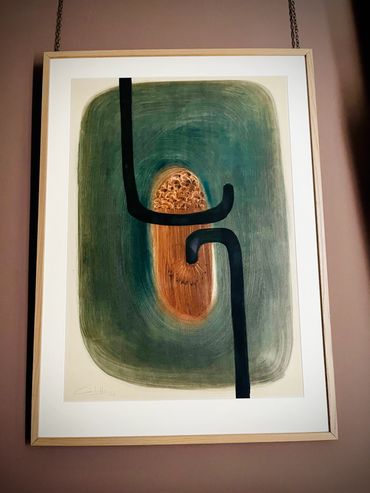

From the mid 60s, for a decade, my Father didn't really pursue his art. He had a young family, had bills to pay, so the day job (architectural assistant) took priority. Then inspiration struck. He spent a year working on a series of paintings, in bright acrylic colours, on themes of tantra, and conception . He must have produced over 40 canvasses. The centrepiece was a grid of 29 paintings designed to fill a wall.
An exhibition was arranged to showcase this new work, and new direction, at the gallery of the Architectural Association. Then, after it was all set up, after the posters had been printed, the AA got cold feet because, apparently, of the 'sexual' nature of the work. The exhibition was cancelled. This was absurd, not least because the imagery was abstracted so much that I doubt even Mary Whitehouse would have objected.
I don't think my Father picked up a paintbrush again for almost ten years.
I was too young to appreciate how disappointed and disillusioned he must have been. Remarkably, he never let bitterness eat away at him over the show being pulled. I don't know how he did that. But I'm not as Zen as him. So I do feel bitterness, on his behalf. And over 50 years on, just to get this out there, I want to say: Cancelling The Show Was Wrong.
I don't need a whole gallery, just one wall would be enough. One wall to display the centrepiece of Leslie Candappa's cancelled show. Now that would be a great story.
So, does anyone. know anyone, at Tate Modern?
Because if you're going to dream, you might as well dream big.
It's an immigrant thing.